Ophthalmology Project in South Sudan
By: Blanca García Sandoval, ophthalmologist at the Fundación Jiménez Díaz
There are times in life when the stars align and magical things happen... Well, that's what happened to me this year.
At first, I hardly knew where South Sudan was, nor that it was the youngest country in the world at barely twelve years old. I knew about the high rates of poverty affecting its population, but I did not know that the country ranked last in the human development index. I investigated and learned that there are only 6 ophthalmologists in the whole country of almost ten million inhabitants, that there is a lack of medical assistance, that there are no paved roads... A whole universe of black holes...
In my search I discovered that, in the southwest of the country, in the state of Western Equatoria, there is a small mission with a beautiful name - Ave Maria - and a beautiful church built 100 years ago by the Comboni missionaries at the end of a mango grove that they planted for those who would return many years later. That 'afterwards' was MCSPA, the Missionary Community of St Paul the Apostlea star that helps people in the Source Yubu area, providing food and crops, shelter for those displaced by the war, education for children and activities for young people, care for the elderly and also health care in a clinic they recently built.

(Missionary Community of St. Paul the Apostle)
It is from them that the opportunity to shed some light appears in my path, but this time through the eyes of many blind people who, due to the impossibility of accessing a health centre, were unable to see. The same thing happened twenty years ago in Turkana (Kenya), and since then the ophthalmology project there has not stopped evolving, becoming more and more autonomous, but always part of my life. All these years have helped me to learn and to want to be part of the same missionary family, whose driving force is faith and commitment.
My life is like many others, I have a husband, children, a mother, family, colleagues and friends who I rely on all the time. I am an ophthalmologist (I work in the Jiménez Díaz Foundation) and that is what I took as a volunteer to South Sudan: my hands to operate, my enthusiasm and a great team.
The stars began to align: I found three ophthalmologists experienced in operating on difficult or nearly impossible cataracts without sophisticated means, an optician to calculate intraocular lenses and an improvised logistician. We found a supplier in Juba, the capital, who provided, albeit not entirely well or on time, many of the things needed for an ophthalmic campaign. We were able, after months, to have the licences to operate, the visas, the flights and vehicles to get to Ave Maria - almost three days' journey from Madrid - and to transport patients from their villages... But there was one star missing: we could not do it alone, not even with the help of my family and friends. We needed more financial support and more institutional backing to be able to carry out the campaign.

June Artachevarria, Mónica Lecumberri and Carlos Moser
The stars were finally aligned when Recover Foundationwhich promotes access to health care for the most vulnerable populations in sub-Saharan Africa, also decided to support the campaign in partnership with Emalaikat Foundationwhich works with MCSPA's local counterpart. It is a beautiful example of how two non-profit organisations have been able to come together and forge a partnership that we hope will continue.
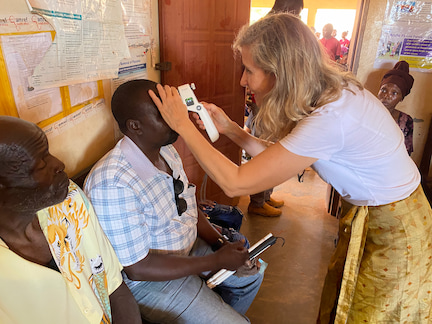
As soon as we landed in Tombura, we screened about 200 patients to diagnose those with cataract blindness so that they could be operated on in the mission. We did the same thing the next day in Ezo. We took visions, looked with the portable slit lamp, measured intraocular pressure, gave treatments...
The day before we started, we spent organising and training our new South Sudanese team, which consisted of a couple of nurses, one Clinical Officer and a person for sterilisation, as well as volunteer boys from the mission to help and translate. That day was a beautiful day, a star that gave its light in the following days of campaigning.
We examined 234 patients at the dispensary, many of them blind due to cataracts, others blind with no solution. We operated on those with cataracts and other operable pathologies. Each patient was a unique and unforgettable encounter; each patient who was able to see the next day was a star that lit up.

The operating theatre was improvised in a room that could accommodate two stretchers and two microscopes. By the way, one of them had to be cooled with a fan to keep it working, because it was very hot. With the suitcases brought from Spain, more full of medication than clothes, we managed to ensure that the quality of the surgery was very good: medication, lenses, sterility, etc., and the organisation was great.
After ten days of campaigning and nights of sharing experiences with the people of the mission, we travelled 9 hours to a hospital near Yambio, in the southwest of the country. There, in Nzara, a Clinical Officer in ophthalmology had a waiting list of almost ninety cataract patients who could not be operated on because they had suffered a stroke months earlier. Over two and a half days we operated on almost half of the patients, three of them children.

The last star towards our return destination lined up in Ethiopia, when we made a stopover in Addis Ababa and screened 37 patients on another mission, many adults and elderly to whom we were able to give close-up glasses.
In total, we screened 721 patients and operated on 132 cataracts in the campaign. The numbers don't matter because each case was a challenge, each case a person. The alignment of so many stars in the form of material things, money, moments and above all people, created a trail of light and vision that we will not forget, that we will repeat and that we are very grateful to each person who collaborated to make it happen.
On behalf of the blind people of South Sudan, we thank all family members and friends, as well as Recover Foundationwho have contributed to making this campaign possible and feasible, for helping them to see the stars again.


 EN
EN  ES
ES  FR
FR